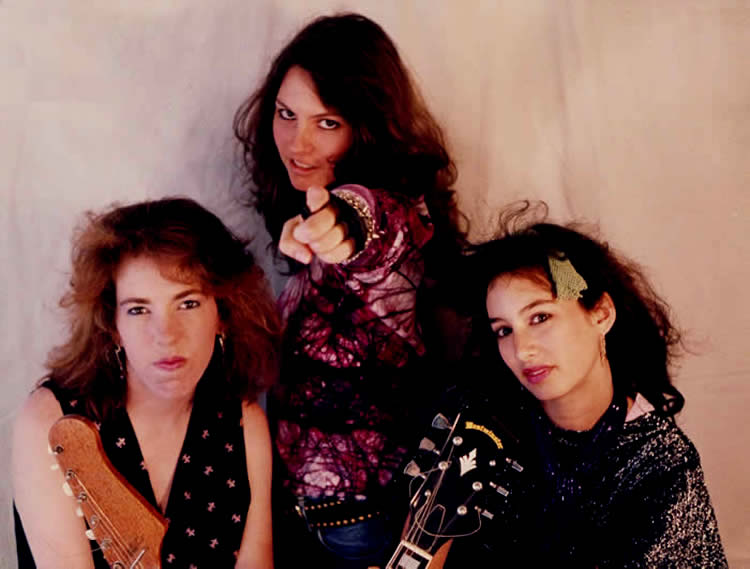
The Lovedolls (first film lineup) Jennifer Schwartz, Janet Housden, & Hilary Rubens (Photo by David Markey) DESPERATE TEENAGE POWER! It was sometime late in 1983 and things were changing in the Los Angeles punk scene. The hardcore heyday of the previous two years was shifting, as far as I could tell. The fanzine I edited and published out of my bedroom in my mother's apartment in Santa Monica along with friends Jennifer & Jordan Schwartz and Kim Pilkington was running out of steam. We were in production of the 6th issue (#666) of We Got Power, when the publication ceased to exist. If you do not know what a "fanzine" is, the name is derived from “fan magazine”. There were many such 'zines self-published across the USA. From major cities to the sticks, fanzines were mostly type-written and photo copied, and usually lovingly put together. Information was slow to come in the early eighties, and if you wanted to get out and hear underground music you had a lot of footwork to do. Fanzine publication was primarily an earnest attempt by kids to take control of the media by creating their own. Rolling Stone was certainly not going to write about these bands and this scene. Fanzines were Truly Needy, and the primary source of information between the countries underground network of Punk & Hardcore. It was 1983 and things were changing inside my teenage head. We Got Power came into being a couple years earlier in 1981. I had just graduated from Santa Monica High School (refusing to participate in the ceremony in lieu of a Black Flag, Adolescents, DOA, & Minutemen gig at the Santa Monica Civic across the street) and had no idea what I was going to do with my life. I picked up a lone drumstick at a thrift store and banged everything I could with it. I worked at Pup 'n Taco where I amused myself by making a Circled "A" (Anarchy symbol) with the sour cream dispenser on the tops of tostadas. I sat behind my Brother typewriter into the late hours of the night working on the 'zine. We Got Power was christened by Alan Gilbert a new friend of ours who was also into this music, named from a Negative Trend song I Got Power off the great Tooth & Nail compilation. Back then this music was so underground that when, if by chance you actually met another kid your age who was also into this scene, it made for the basis of a friendship. Alan lived nearby, although North Of Wilshire (Wilshire Boulevard being the economic dividing line between the lower middle class, and the more well off of the Westside of Los Angeles.) There are no apartment buildings north of Wilshire; mostly nice suburban homes. I, on the other hand lived in a small apartment (south of Santa Monica Blvd.) with my recently widowed mother. My father died of alcoholism when I was 13. Alan and I wholeheartedly agreed on music, for example we both had a fondness for The Electric Eels “Agitated” single, the debut Meat Puppets 7” “In A Car”, the Red Cross “Six Teen Punk Anthems” (Posh Boy) EP, and Half Japanese “No More Beatlemania” 7”. However Alan would soon bow out as he went off to college at UC Santa Barbara and I took over as editor. Alan can be seen in my 1982 Super 8 documentary The Slog Movie in the “A Day In The Life Of A Punk” sequence with a raging case of acne. I had known the siblings Jordan and Jennifer Schwartz a couple years before the L.A. Punk scene would engulf us as kids from my neighborhood. We had already bonded on new wave music like Devo, B-52's, Talking Heads, Elvis Costello, The Specials, etc. But something happened to us after hearing the soundtrack to the forthcoming LA Punk documentary The Decline Of The Western Civilization. Between that record and the Dead Kennedy's Fresh Fruit From Rotting Vegetables, Black Flag's Jealous Again, and X's Los Angeles, we were getting into some pretty heavy stuff. Jennifer drew the cover of the first issue, a caricature of a punk kitty with an added “Anarchy” necklace by yours truly. We were bored teenagers trying to amuse ourselves, and spread the word of these bands and their music. We Got Power was different from most fanzines of the time. First and foremost, it had a unique sense of humor and did not take itself too seriously; focusing on people in the scene almost as much as the bands and the music. The 'zine came complete with goofy puzzles ("Help The Punk Find The Safety Pin" maze) and jokes (such as Q: "Why Did The Punk Cross The Road?" A: "Because he was safety pinned to the chicken.") We Got Power also had a glossy cover and Day-Glo colored ink high quality paper in contrast to the usual newsprint or Xeroxed fare. There was the usual gig and record reviews, band interviews, & scene gossip, all keeping it's punk tongue in cheek. Not bad for teenagers having fun, which was the bottom line in fanzine publication. We were certainly not in it for the money. The magazine brought us into contact with many bands, not only from the Southland, but the few that were able to get on the road at the time (Minor Threat, Government Issue, Bad Brains, The Necros, & The Misfits.) My mother’s apartment and the neighboring Schwartz condo became a stop for many touring bands. You would find In A Free Land era Husker Du hanging out. I remember a worried Bob Mould playing me the rough mixes for Everything Falls Apart in my bedroom, wondering how their Hardcore fanbase was going to react to their “new sound”. Dayglo Abortions would stop in for a visit. Maximum Rock N Roll’s Tim Yohannon would stop by whenever he was in the area. (As a footnote, I wrote the Southern California scene report for the first couple years of that long running publication.) We would usually end up at a lifeguard tower on the beach in the middle of the night drinking a case of Lucky Lager beer, the beer that had puzzles under the cap. I recall Lee Ranaldo and Steve Shelley spending a night or two at my mom’s, back before Sonic Youth could afford to pay for hotel rooms. Henry Rollins tripped an all-nighter at the Schwartz condo. The former Washington DC Straight-Edger was spreading his wings on the west coast. Henry had long since changed his last name from Garfield to Rollins, started in on tattoos, and grew his hair long. He was hanging out with Kim Pilkington around that time.
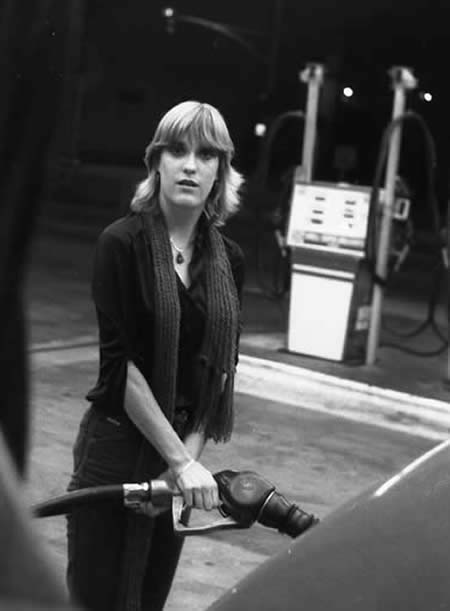
Kim Pilkington gassing up her Gremlin in 1983 (Photo by Jordan Schwartz) We ended up interviewing the cream of the crop of American Hardcore: Flipper, Circle Jerks, Red Cross, Saccharine Trust, Dead Kennedy’s, DOA, Black Flag, Minor Threat, Bad Religion, Suicidal Tendencies, The Misfits, Husker Du, & The Necros. I don't remember exactly how we pulled it off for the two years of its existence. Much of it had to do with the good graces of the printer, Mr. Macias, father of John Macias (singer of Circle One) who ran his own print shop in South Central Los Angeles. Because we had covered his son's band in the first issue, he insisted on giving us his best paper and printing quality at a reduced rate. We did also sell a decent amount of ads, and we did host a benefit show consisting of Bad Religion, Minutemen, Descendents, Symbol Six, & my band Sin 34 at Godzilla’s that must have brought in at least $500. Through the 'zine, Jordan and I compiled the Party Or Go Home compilation LP (1983 Mystake Records) featuring an amazing line up of national (and Canadian) bands such as 7 Seconds, The Minutemen, The Big Boys, Red Cross, Nip Drivers, JFA, Dr. Know, Tar Babies, Mecht Mensh, Dayglo Abortions, Rebel Truth, The Patriots, White Cross, White Flag, & a host of others doing 60 seconds or less of their fastest thrash (for the most part.) It's a great collection. Mike Watt wrote a song especially for this compilation (and Jordan Schwartz) called Party With Me Punker which he recorded with the Minutemen. To the observant "Hardcore" was over midway through the decade, for us the writing was already on the wall in late 1983. Everything fell apart; bands broke up, friends disappeared, clubs closed doors, and the scene as we knew it died away. Thankfully however much grew from our time with the ‘zine. I was busy playing in bands (Sin 34 and Painted Willie), recording records, touring and I still found the time to make a film every couple years or so. Jordan went on to work for Chuck Dukowski’s Global Management, which handled the bands on SST, of which I would also soon become a part of during the post-hardcore era. You can see Jordan on the cover of Black Flag's Annihilate This Week ep (in a parody of Rambo no less) and the star of the Slip It In music video I co-directed in 1984 with Dave Travis. That's also Jordan's chicken scratch penmanship all over the cover of Flag's Who's Got The 10 & 1/2.
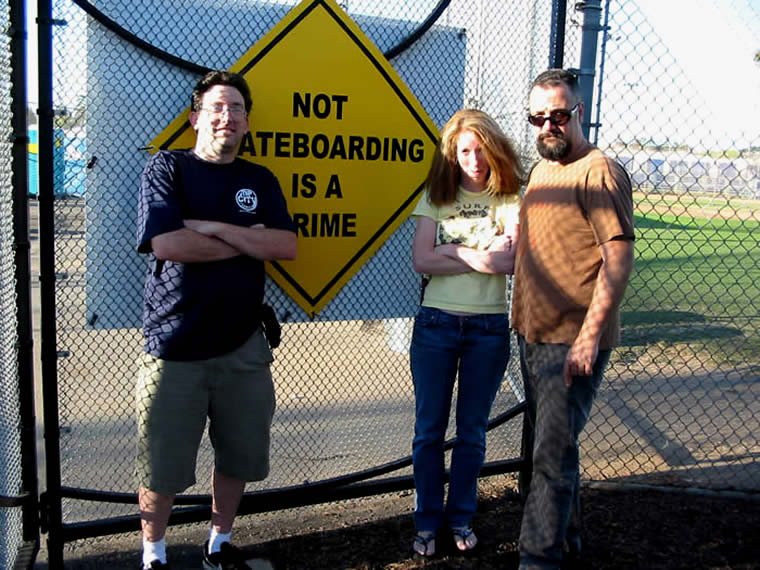
Jordan Schwartz, Jennifer Schwartz, & Dave Markey in Santa Monica 2005 (Photo by Dan Clark) We Got Power magazine was dead and We Got Power Films became my primary focus. After completing the cinema verite' The Slog Movie in 1982 (which featured many of the bands that appeared in the pages of We Got Power including Circle One and John Macias, Henry Rollins and Black Flag, Red Cross, The Cheifs, TSOL, Wasted Youth, Fear, Circle Jerks and others, I wanted to return to a narrative feature. I was prompted to begin shooting a cinematic endeavor as a vehicle for Kim Pilkington's and Jennifer Schwartz's aspiring tongue-in-cheek rock 'n roll dreams. I gave them the name The Lovedolls, and I titled the film Desperate Teenage Runaways in a nod to the 1970's LA all-female band The Runaways, whose story we were decidedly NOT going to tell. Jennifer was more than ready to handle the lead after having previous supporting roles in my backyard films. Talk about method, she became the star-searching Kitty Carryall overnight. She collaborated with me on the script, which we made up as we went along. I featured the Schwartz's in my 1980 horror film parody The Omenous. Jordan is one of the most hilarious and individually a skewed people I have ever known. His dual roles in the film, as the overly smiling psyche-ward doctor and the very shrill, Kitty's (unnamed) mother were both so dead-on, no one ever recognized the two as being acted by the same person. He also acted as "executive producer", supplying the spare change that was needed for production. From behind the eyepiece of my Elmo Super 8 sound motion picture camera, our makeshift nod to Beyond The Valley Of The Dolls began to take shape. Actually I didn’t even see this Russ Meyer / Roger Ebert masterpiece until well after we had wrapped shooting Desperate Teenage Runaways, but it was a favorite of Redd Kross (still known at the time as Red Cross, prior to the American Red Cross' cease and desist), who we had met and interviewed for our ‘zine at Oki-Dogs under fluorescent lighting. We found we shared a similar taste for trash culture and the 1970's. Keep in mind this was before the nauseating cross-cultural affinity for that timeframe kicked in. Back then, the very idea of a Brady Bunch film was so far from reality, we actually considered doing it ourselves. We also considered doing our own Charlie's Angels (via Charles Manson). In short, if it wasn't for Redd Kross, this film would probably not exist.
Jeff McDonald & Steve McDonald Red Cross 1982 (Photo by Jordan Schwartz) We started production on Desperate Teenage Runaways before we had any idea of what we were doing. There are much better ways to approach filmmaking, but sometimes you can't deny the moment. There was no screenplay proper, although a great deal of dialogue and scenes were pre-planned. A lot of improvisation was going on too. All of the extras in the film were actually there on the street at the time of filming. There were no sets. There were no caterers. We used household lamps as movie lights. There certainly wasn't any studio. The film was processed at Thrifty mart. Everyone knew their place, and somehow it all clicked. Imagine our excitement when Runaways producer Kim Fowley showed up at the Friday the 13th (of July 1984, at the Lhasa Club in Hollywood) premier of the film. It was to be short lived however as it was clear Fowley had his own agenda for being there; he was clutching a suitcase he said was loaded with explosives. He threatened to blow up the building and kill us all. He came in tow with a large black woman dressed to the hilt in Jungle Jane drag clutching a spear, who he introduced as his body guard and a member of the "New Runaways" that he was forming at the time. Fowley was livid, insinuating we had ripped off his life story without actually not even seeing the film. He threatened that Joan Jett and Sandy West would kick our asses, after the fact that he had parted ways less than amicably with The Runaways years before. It was just like a Scooby-Doo episode. A creepy old man was trying to scare a bunch of kids, but he only amused them. We named a character in the sequel Lovedolls Superstar after him (Slim Crowley), played by Bob Moss (who was featured in The Ramones I Want To Be Sedated video, and in a Got Milk? TV ad, both times playing a doctor.) I suppose it didn't help that we had actual Runaways songs dubbed in the film during the live performances, which was obviously the first thing to go. I was a punk kid who made a no-budget Super-8 feature for fun with friends on weekends, what did I know about sync-rights? In all actuality Fowley was probably trolling for a little publicity in The LA Weekly, which he got. “Kim Fowley was seen throwing a huge stink fit at the premier of Desperate Teenage Runaways. All this over a Super-8 film with a budget less than a power meal at Spago.” Wrote Craig Lee (his former band The Bags have a song in the film.) After making the mistake of giving Fowley my phone number, I decided a title change was in order as he was threatening litigation, amongst other things. I'm very glad I complied; after all, it was the story of the rise and fall of The Lovedolls. I couldn't imagine the film being titled anything else. Thanks Kim! I suppose Fowley could have seen a lot of himself in Steven McDonald's tour-de-force performance as the conniving record magnate Johnny Tramaine. Steve's acting ability was apparent to me right away. The way he was able to get into his character was remarkable for a 15 year old first time actor. This publicity paid off in a big way. The subsequent Lahsa Club screenings were all sold out and there was a demand for the film on VHS and Beta! After selling several hundred tapes at shows, on consignment at local redord stores, or through mail-order; we settled on a distribution deal with a small, fledging company known as Hollywood Home Video which ran out of the back of a video store across from Hollywood High School. They printed up a full color cover and encased it in a clam shell box. We were pleased to see them sell a couple thousand copies of the VHS, with the help of continuing positive press and word of mouth. In fact, one of the biggest buyers of the film was the notoriously straight and fundamentally Christian, Blockbuster Video who reported back an incredibly high rental of the title. We were surprised to see this beyond low budget film take off the way it did. This film was made to entertain our small circle of friends. It was filled with in-jokes we thought no one would understand. I never thought the combination of Led Zeppelin's Stairway To Heaven inter-cut with incidental music from the Brady Bunch, would strike such a resounding chord. There was a thrill of seeing positive reviews in the Los Angeles Herald Examiner, and LA Times, along side of the big Hollywood fare of the day; Flashdance, Footloose, Desperate Teenage Lovedolls. No one was working publicity, it was happening all by itself. The word spread nationally through various fanzines as Flipside, Flesh and Bones, and Suburban Relapse. The Village Voice gave us a rave review, as did other mainstream publications. Eventually the film would be featured in a sketch on Jay Leno's Tonight Show. Marylin Manson liked the film enough to sample Steve McDonald's dialogue ("Those Fuckin' Bitches...") and of course "Thanks for killing my mom." Redd Kross certainly helped build the film's infamy, re-recording Ballad Of A Lovedoll for their Neurotica LP.
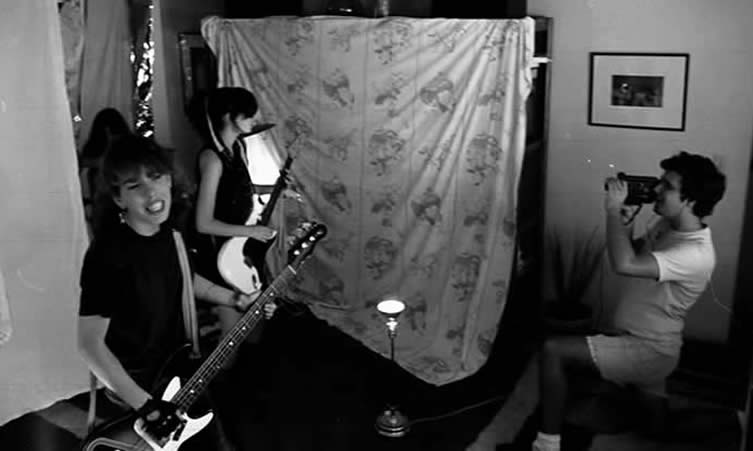
Dave Markey shooting "Desperate Teenage Lovedolls" in 1984 (Photo by Jordan Schwartz) I have to dig deep to recall all that was going on behind the scenes, which actually was the true force in what was going on the screen. To an extent, everyone played themselves, or their alter-egos, which became indistinguishable as the film gained notoriety. At times, it almost played as a documentary of our scene. By the time the sequel was completed two years later, The Lovedolls became a real band, packing nightclubs in LA, and even touring nationally. Drummer Janet Housden was playing in Redd Kross at the time, and sometime during the filming she was kicked out of the band. I remember that made for a few tense moments, especially when we filmed the live Lovedolls sequence at an actual benefit for the film at the notorious Hollywood dive punk basement, the Cathay De Grande, in December of 1983. Janet was to use her replacement drummer Dave Peterson's kit, and I remember she was threatening to destroy it. I am glad she didn't, Dave not only turned out to be a great drummer, but he proved to be an equally apt producer/engineer (check out Ballad Of A Lovedoll, the great theme song and Legend, and marvel how he produced this in a bedroom on a four-track.) I do recall how much attitude Janet packed during filming. She was perfect as Patch, and could have kicked anyone who ever hassled us for a permit asses without blinking. "Thanks for killing my mom... No problem!" (my dialog, which fast became the film's tagline.) Janet was not the only X-Redd Kross member in the film. Tracy Lea practically steals the show as (Tanya Hearst), and Dez Cadena (Flaco) both one-time guitarists for The Kross, graciously lent their acting talents to the film. Dez has been in many bands including The Happy Tampons, Black Flag, DC3, Twisted Roots, The Misfits, Lipstick Sandwich, Carnage Asada, & Lou Renaldo. Tracy, Dez, and Janet are also heard on the soundtrack in RK's various stages of incarnation. Jeff McDonald appears in a cameo (Tears Brunell, "But you can call me Donut.") in which he is hardly recognizable as a Venice street person in an afro wig and purple fur overcoat. He is later bludgeoned to death with his own guitar. The Lovedolls films capture the dark side of Hollywood in the 1980's. To walk down the clean streets of Hollywood today, one sees a Disney-fied shopping mall. The Hollywood captured in these films is seen in it's truly sketchy, druggy & hooker filled glory. The homeless characters in the film are the real deal. We had asked some of the more colorful vagrants of Venice Beach and Santa Monica to act in the film in exchange for a bottle of Thunderbird. I regret not getting their names for screen credit at the time of filming (always too hectic), as their performances (as in; "Do you girls have any doobies for sale?") ad a surreal element you couldn't get otherwise. If you are at all familiar with the VHS version(s) of the film, you may notice a few changes on the soundtrack for the 2003 DVD reissue. My former associate, Black Flag founder / SST Records owner Greg Ginn phoned my distributor (Eclectic / Music Video Distributors) and threatened suit over the 15 seconds of the aptly titled Black Flag song Life Of Pain in Desperate Teenage Lovedolls. This was after the DVD was produced and manufactured. Keep in mind this is the same song that was in the film for 20 years. The same song that he agreed to let me use all those years ago. The same song that was featured on the original soundtrack LP he re-released (the original issue being on Gasatanka Records). There was no contract beyond verbal and a hand-shake, which would lead to this almost two deacde later back-stab. 3000 DVDs were destroyed and the film itself, the dvd, and the dvd artwork all had to be redone at my expense. Here's a man who I was involved with on a dozen recorded releases, who never paid up on any of them. Of course he is notorious for not paying his former associates; bands or band members.
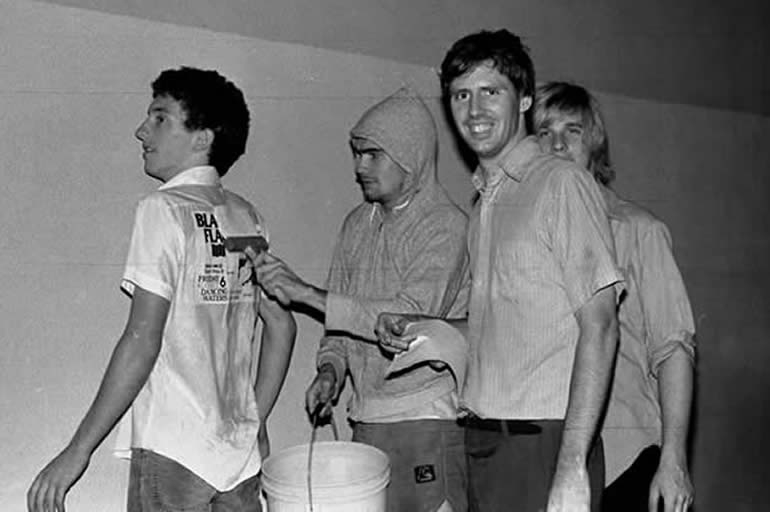
Jordan Schwartz gets Flagged in 1982 (Henry Rollins, Greg Ginn, & Chuck Biscuits) (Photo by Dave Markey) I had to remove Ginn's content from three of my feature films in total, deeply regretting any past association with him; Lovedolls Superstar being the most dramatic (as he came into my studio and scored the film back in 1985.) Ginn has had it in for me ever since I completed the 1986 Black Flag tour film Reality 86'd in 1991. A film I shot when I was on that relentless six month tour which not surprisingly turned out to be the bands swan song (I drummed and sang for the support band Painted Willie.) A film he has long prevented from being released, even when offered up to him to release. Such a shame, as it is a unique historical document that begs to be seen. Don't hold your breath for an official release, at least not for the time being. However, I hear it is all over the net, if you are into that kind of stuff. Personally for me being a filmmaker, I have never once downloaded a film from bit-torrent site in my life. However, I will not be offended if you do. As Henry Rollins says, "I'd rather be heard than not paid." Or in this case, seen and heard. - David Markey |